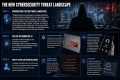
All right, let's talk about cyber security. You know, it feels like defenders are always playing catch-up, always one step behind. Well, today we're diving into a huge shift in that race. How AI is flipping the script, moving security teams from just reacting to threats to actually predicting them. Let's jump right in. So, what if your security system wasn't just a silent alarm, but more like a detective? I mean, a detective that could actually understand your entire digital world, connect all these seemingly random clues, and then, get this, predict what an attacker is going to do next. That's the promise here. And that's exactly what we're breaking down. You know, the biggest problem for any security operations center, a sock, isn't a lack of data. Oh, no. It's the total opposite. They're absolutely drowning in it. Just picture this. a constant storm of alerts coming from dozens of different tools, none of which are speaking the same language. The real challenge connecting those dots before it's way too late. Okay, so this is where a whole new approach comes into play, all built around the Microsoft Sentinel platform. The whole idea is to create a single command center to bring some order to all that chaos. Let's break down the three key parts. First up, you've got the foundation, the Sentinel data lake. The best way to think about this is like you're about to solve a giant jigsaw puzzle, right? Before you can even start to see the picture, you've got to get all the pieces out of their separate boxes and dump them onto one table. That's exactly what the data lake does. It pulls together security data from hundreds of places. Your cloud, your network, your apps, everything, all in one spot. So now you've got all your data on the table. How do you possibly make sense of it all? Well, that's where the Sentinel graph comes in. This thing is like the classic detectives corkboard with all the red string connecting clues. It automatically maps out the relationships between all your users, devices, and data. And just like that, it shows you hidden attack paths and what we call the blast radius of a potential breach. And this this brings us to the AI master detective, the Sentinel MCP server. Okay, this is the real gamecher. It means analysts can finally ditch writing complicated code and just ask questions in plain English. The AI then does all the hard work reasoning over all that unified data to find answers and stop threats way, way faster than ever before. All right, so that's the theory. Sounds pretty cool, right? But how does it actually hold up in a real world attack? Let's walk through an investigation step by step and see these tools in action. So here's the scene. Our investigation kicks off with an alert for a pretty nasty multi-stage attack. And we found the entry point, a user named Mark Gafar. His credentials have been compromised. Now, in the old days, this would set off a frantic manual scramble for clues. But not anymore. The process today is so much more streamlined. It's really three steps. First, the analysts can instantly visualize the potential blast radius. Second, they just ask the AI for context, you know, using natural language. And third, they expand the hunt based on what the AI finds. In cyber security, speed is literally everything. And this is built for speed. So instead of wasting precious time trying to write some complex query, the analyst just asks plain and simple, what do we know about user Marafarava and his actions? And from there, the AI does the heavy lifting, running a bunch of queries in the background to piece the whole story together. And bam, almost instantly, the Sentinel graph shows the attacker's most likely next move. It identifies the shortest path to a really high value target, a critical asset called the WG prod key vault. Now, knowing this ahead of time, that is a massive advantage. It lets the security team get out in front of the attacker for once. But, you know what? If the risk isn't just sitting in your cloud infrastructure, a lot of the time, these threats can stretch all the way into your core business applications. So, let's see how the system can be customized to connect those dots, too, giving you an even bigger, clearer picture. And here's where you can really see that next evolution. On the left, you've got your standard security view. You know, your users, devices, cloud stuff. But on the right, that's the custom view. By pulling in data from a critical business app like Salesforce, you create a much, much richer identity graph. You're mapping security risk directly to business risk. Now, with all this richer data, the analysts can ask way more powerful questions. So they pivot to another user, Alberto Pock, and ask the AI to analyze him using this new custom graph. They ask specifically, is there a risk to Salesforce? And the answer comes back as a definite yes. The AI uncovers that Alberto is a help desk admin with some seriously dangerous